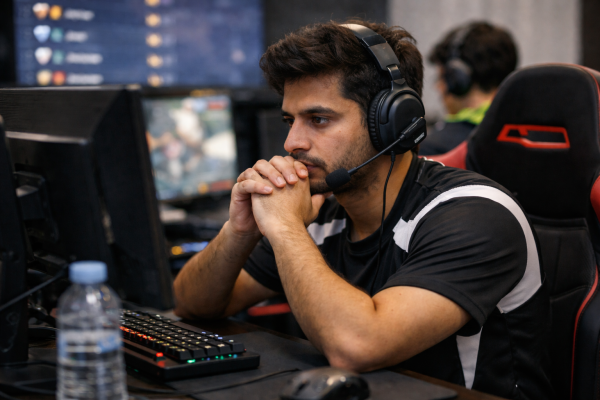
Competitive gaming produces psychological experiences that are disproportionately intense relative to the stakes involved. A loss in a ranked match — where nothing material is on the line — can produce frustration, self-doubt, and occasionally genuine anger that players themselves acknowledge is out of proportion to what actually happened. A win in a close series can feel genuinely euphoric. Understanding why requires looking at the psychological mechanisms that competitive games activate, not just the social norms that have developed around them.
This article explores several of those mechanisms: motivation theory, the ego's role in performance, the phenomenon of tilting, cognitive bias in self-assessment, and how the structure of competitive games intersects with all of the above.
Why Do We Play Competitive Games?
Self-determination theory, developed by psychologists Edward Deci and Richard Ryan, identifies three core psychological needs that drive intrinsic motivation: competence (the desire to feel effective), autonomy (the sense that you're acting from your own will), and relatedness (connection to others). Competitive games are unusually good at satisfying all three simultaneously.
Competence is the most obvious. Ranking systems, performance feedback, and the clear win/loss structure of competitive play give players continuous, legible information about their effectiveness. Unlike many real-world skill domains — where feedback is slow, ambiguous, or filtered through social courtesy — games give you an unambiguous result at the end of every match.
Autonomy is present in the freedom of strategic choice: which character to play, which strategy to pursue, when to take risks and when to play it safe. Even in games with established approaches, players experience their choices as genuinely theirs. And relatedness is built in through team formats, shared frustration over losses, and the broader gaming community — the sense of belonging to a group defined by a shared activity.
The combination of these three elements in a structured, feedback-rich environment is a significant part of why competitive games are so engaging over long periods. It is also part of why leaving them can feel difficult even when the experience is regularly frustrating.
The Role of Ego and Identity
One of the most psychologically significant features of competitive gaming is how closely players identify with their in-game performance. When someone describes themselves as a "Diamond player" or a "gold-ranked main," they are doing something more than citing a ranking: they are stating part of their identity. That identity is then subject to all the same protective mechanisms that psychological research consistently finds around self-image.
Carol Dweck's research on mindset is relevant here. Players with what Dweck calls a "fixed mindset" tend to interpret losses as evidence of fixed, inherent ability — a view that makes failure feel threatening to their sense of self. Players with a "growth mindset" are more likely to interpret the same losses as information about what to practice next. In competitive gaming communities, the language players use when discussing losses reveals which orientation they are operating from: "I just do not have the mechanics for this game" versus "my crosshair placement was off and I need to work on it."
This is not a moral distinction. The fixed mindset response to failure is not a character flaw; it is a cognitive pattern that appears across all kinds of performance domains and that significant environmental factors can reinforce or discourage. Ranking systems that define a player's worth by a number, combined with community cultures that mock low-ranked play, create conditions that make fixed-mindset responses more likely regardless of individual disposition.
Tilting: What It Is and Why It Happens
The term "tilt" in gaming refers to a state of emotional disruption that degrades a player's decision-making and performance. The word is borrowed from competitive poker, where it describes a similar phenomenon: a player who has taken a bad beat and is now playing emotionally rather than strategically. In gaming, tilt typically follows a loss, a teammate conflict, or a perceived injustice — an outcome that feels unfair, even if it was within the normal variance of the game.
From a cognitive standpoint, tilting involves several overlapping effects. Emotional arousal narrows attention — a well-documented phenomenon sometimes called perceptual narrowing — which means a tilting player is literally taking in less information than they normally would. They are more likely to miss signals they would otherwise catch, and more likely to fixate on the thing that went wrong rather than adapting to what is happening now.
Tilting also tends to produce a shift in motivation: from performance-oriented goals (play well, make good decisions) to outcome-oriented goals (win this match, recover the ranking points). Paradoxically, outcome orientation frequently produces worse performance than process orientation — because it directs attention to the scoreboard rather than to the moment-to-moment decisions that actually determine outcomes.
The self-awareness required to recognise tilt while experiencing it is genuinely difficult. Players often know, in retrospect, that they tilted, but find it hard to identify the state while in it — which is exactly when that recognition would be most useful. This is one of the reasons professional esports teams began integrating mental performance coaches: the skill of managing emotional state during competition is trainable, but it requires external input to develop effectively.
Cognitive Bias and Self-Assessment in Gaming
Competitive gaming is also a rich environment for observing cognitive biases that appear in other domains but are often more visible here because of the volume of available data and the clarity of outcome signals.
The self-serving attribution bias is common: players tend to attribute wins to their own skill and losses to external factors — lag, teammates, unlucky randomness, poor game balance. This is not unique to gaming; it is a well-documented feature of human cognition across domains. But in competitive games, the external factors are real enough to provide genuine cover for the bias. There is lag; teammates do make mistakes; randomness is built into many game systems. The bias operates by selectively attending to these factors when they explain unfavourable outcomes and ignoring them when outcomes are favourable.
The Dunning-Kruger effect is frequently referenced in gaming communities. The actual research finding is more nuanced than the popular version: it is not simply that incompetent players overestimate themselves, but that people at all skill levels have imperfect self-assessment, and the calibration between self-perception and actual performance tends to improve as genuine expertise develops. In gaming, this manifests as the common experience of players overestimating their rank relative to their actual placement — a gap that tends to narrow as players move up and the competition gets consistently more capable.
Game Structure and Psychological Outcomes
Psychological outcomes in competitive gaming are not solely a function of individual psychology. The design of competitive systems themselves has real effects on how players experience and process competition.
Rank decay systems — which penalise extended inactivity — can create anxiety around breaks that affects how players manage their time with a game. Variable reward schedules in ranked play (where a win streak can suddenly reverse) are known to produce both elevated engagement and elevated frustration in ways that fixed schedules do not. Matchmaking systems that prioritise fair matches do so at the cost of consistency: a fair match is, by definition, one that either side could plausibly win, which means roughly half of all matches in a well-calibrated system will result in a loss. Players who do not account for this mathematically often interpret normal variance as evidence that something is wrong with the system or with themselves.
Community culture layers on top of all of this. Environments that normalise verbal abuse in competitive play make the emotional costs of losing higher and more personal. Communities that develop norms around constructive feedback and mutual accountability tend to report different experiences with the same games.
Applying This Understanding
None of this makes competitive gaming inherently harmful or requires players to approach it with clinical detachment. The emotional investment is largely what makes competition engaging — if you did not care about the outcome, the experience would be considerably less interesting. The question is whether that investment is being managed or simply experienced.
A few practical observations emerge from the research. Paying attention to win/loss streaks and recognising when emotional state has deteriorated — and then stopping — is a genuine skill that experienced players often develop. Keeping records of what you did in matches rather than just the outcome builds the habit of process focus. And investing time in genuinely understanding a game — its history, its design rationale, its community — tends to sustain motivation through difficult patches more reliably than focusing purely on rank.
That last point is one of the reasons knowledge-based engagement with games, rather than purely competitive engagement, has value. A player who understands why a game's systems work the way they do, who knows its history, and who can articulate what they find interesting about it has a different relationship to both success and failure within it. The quiz formats on Zantrexio are oriented toward building that kind of knowledge — not as a performance tool, but because it tends to make the experience of playing more satisfying and more durable over time.
Test your understanding of gaming mechanics and competitive concepts with our quiz library.
Explore Quizzes